Earth Day was a big one this year for Heidi Adams, founder and CEO of BASEstud.io. It was the day she was able to stop telling people about her next-generation streetlight and show them what it could do.
BASEstud.io ran a live demonstration of its platform on April 22, 2026 in Rancho Mirage, co-presented with Los Angeles Cleantech Incubator and the Visit Greater Palm Springs Economic Development Office. On display was a system that turns streetlight infrastructure into a tool for lighting, distributed energy, Wi-Fi connectivity, and curbside EV charging, including Level 2 charging for neighborhoods, campuses, and commercial districts.
The response was immediate.
Before the week was out, Adams was fielding requests. The Indio City Manager wanted a meeting. The Indio City Council requested a formal presentation. The CVAG Transportation Director asked for technical specifications. Eight additional introductions followed across the municipal, utility, and development sectors.
“What shifted was the nature of the conversation,” Adams says. “Before the pilot, we were explaining what the technology could do. After the pilot, we were responding to people who had seen it working firsthand.”
SO MUCH MORE THAN A STREETLIGHT
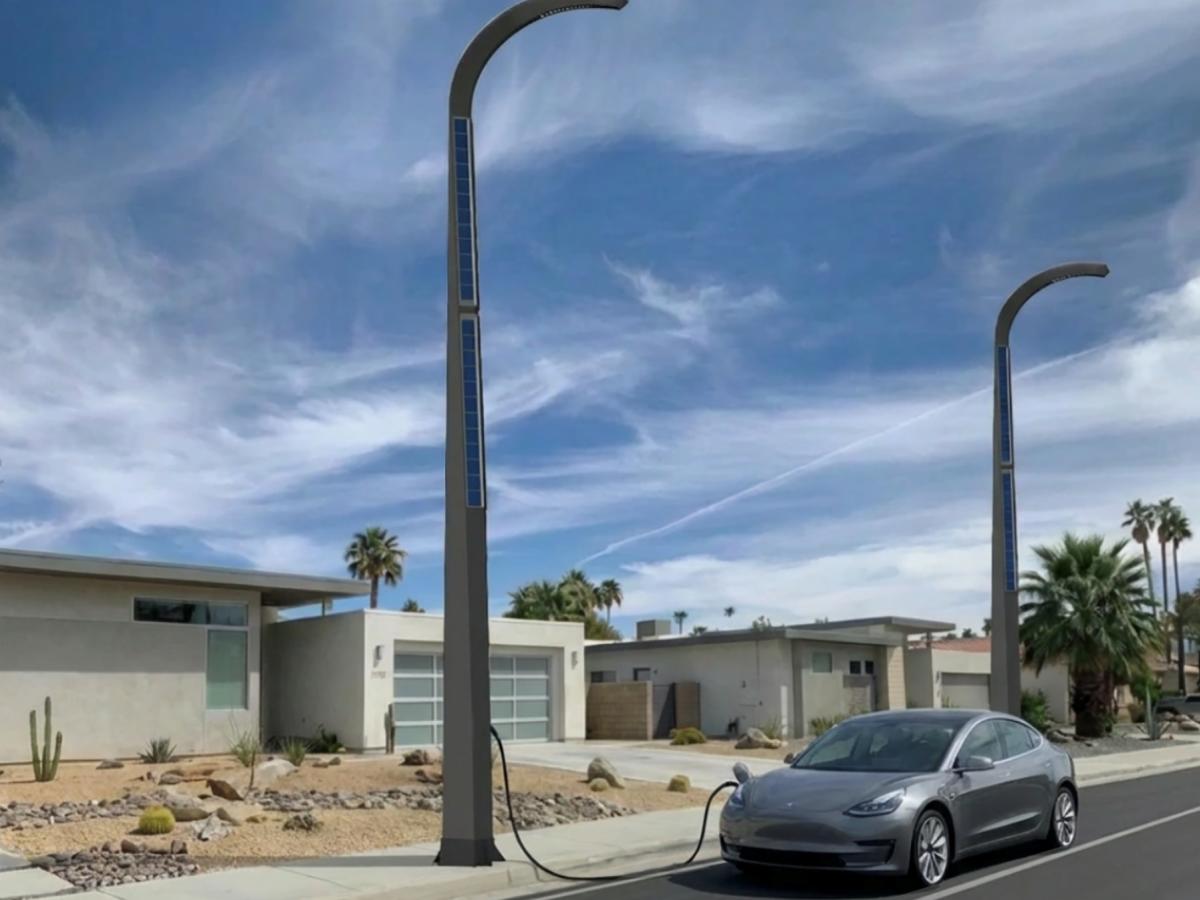
BASEstud.io is built around a simple idea: The streetlight can do more than illuminate three colors. Instead, it can be something more useful, resilient, and connected.
For Adams, the idea grew out of daily life in the desert.
“What the valley offers that almost nowhere else in California can match is the combination of genuine climate conditions, rapid growth, and a regional network that moves,” she says. "Greater Palm Springs made a compelling case that it should be built here. We agreed.”
Adams’ background in film production also influenced the way she thinks about reliability. On a production set, the equipment has to work in real conditions, under pressure and on schedule. She brought that expectation to infrastructure, designing a platform around the conditions cities already face, including heat, outages, connectivity gaps, and the growing demand for curbside EV charging.
TESTED IN THE DESERT

Greater Palm Springs has become more than BASEstud.io’s home base. It’s part of the product story.
“You can’t engineer for the desert from a conference room in San Francisco,” Adams says. “You have to build it here, test it here, and live in it. Greater Palm Springs isn't a single climate condition – it's a full-spectrum proving ground.”
Adams made sure to use all of the extremes to her advantage. This included hot temperatures, Santa Ana winds, flash floods, freezing nights after scorching days, and pressure and moisture swings that stress materials in ways many markets cannot.
“For infrastructure design, that's not a liability,” she explains. “It's the most valuable laboratory in California. Every company building technology that needs to perform in the real world should be asking whether they can afford to develop it anywhere else.”
That mindset is already helping the company advance. Southern California Edison recently issued a formal letter of support for BASEstud.io that cited the company’s demonstrated technical capability, which Adams proudly notes “was developed and proven here, in this heat, on these streets.”
A REGION THAT MOVES

The climate may make Greater Palm Springs a natural testing ground, but Adams says the region’s support system has been just as important.
“Greater Palm Springs treated us like we belonged here before we had anything to show,” she says, while crediting the Visit Greater Palm Springs Economic Development team with making introductions, opening doors, and publicly supporting the pilot. “They didn't just host our pilot. They gave us the proof that every subsequent conversation rests on.”
Conversations are now advancing with Eisenhower Health, which reached out about its own pilot, as well as with city, utility, development, and regional transportation leaders.
To Adams, that response says something larger about the valley. Greater Palm Springs combines genuine climate conditions, rapid growth, and a regional network that includes nine cities, 12 unincorporated communities, five tribal nations, and thousands of new homes. The result is a market where the need for modern infrastructure is visible and the willingness to engage is real.
“We didn't come to Greater Palm Springs to launch,” Adams says. “We came because it was the right place to build something that lasts. That distinction matters, and other companies looking for a home for serious work should pay attention to it.”