Where Manufacturing Works Again in California: The Greater Palm Springs Advantage
For many companies, manufacturing in California is a study in trade-offs. On the one hand, you can access talent and markets. On the other, rising costs, limited land and regulations are common, consistent hurdles. Striking a delicate balance between the two is becoming increasingly harder, often resulting in stalled expansion plans or tabled relocations.
Fortunately, this narrative isn’t playing out statewide.
Manufacturers who operate in Greater Palm Springs are finding something increasingly rare in California: the ability to move forward in a timely, cost-sensitive and realistic way.
With direct access to Interstate 10 and freight rail, proximity to major Southern California markets and the Southwest, and the kind of available land that’s all but disappeared in coastal metros, the region is removing many of the barriers that have slowed manufacturing growth across the state.
“Greater Palm Springs offers a unique combination of available land and a strategic location that serves as a gateway between Los Angeles and the broader Southwest,” says Antonio Carvajal, founder of Next-Machina, a design and advanced manufacturing studio focused on prototyping and building complex products, such as electric vehicles and modular housing systems.
BUILT TO SCALE, NOT STALL
As Carvajal knows, it’s not just about space for a company, but what a space enables. Those looking to grow must prioritize faster timelines, scalable operations, and the ability to test, build and expand without the bottlenecks that mar so many traditional, long-built-out hubs.
“For a company focused on manufacturing and logistics, having the physical space to scale – which is increasingly rare in coastal hubs – while remaining connected to major infrastructure is a significant advantage,” Carvajal adds.
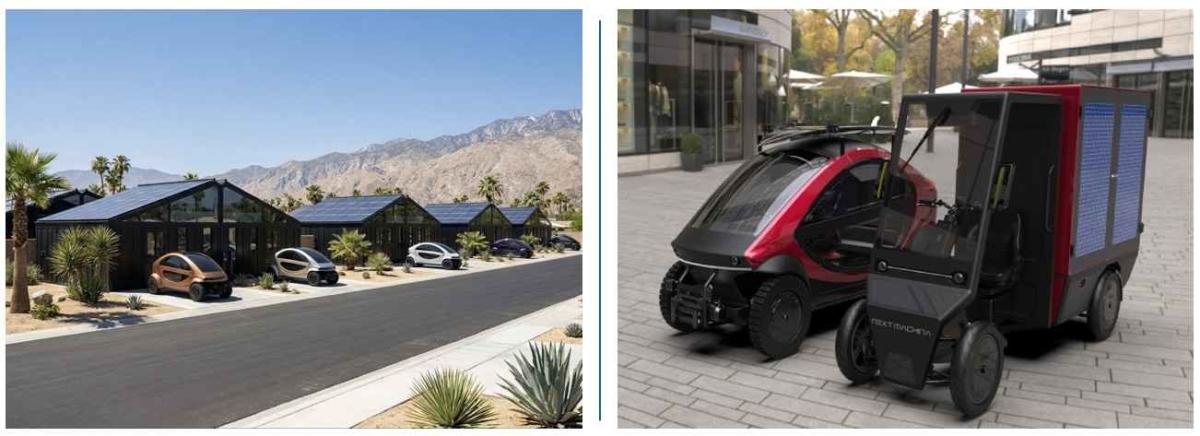
Backed by continued investment in infrastructure, mobility and utilities, Greater Palm Springs is positioning itself as a place where advanced manufacturing thrives. Removing friction from the already challenging process of scaling also enables manufacturing companies to devote their energy to what they do best: manufacture.
“Being based here has allowed Next-Machina to focus on the R&D and assembly of specialized electric vehicles and modular housing systems like our V-House with room to grow,” Carvajal explains. “The region is also beginning to foster a specialized ecosystem that is becoming very attractive for innovation-driven sectors like cleantech and sustainable construction.”
That ecosystem is already shaping how companies consider what comes next. For Next-Machina, it means advancing long-term strategies around integrating advanced materials like basalt fiber into more sustainable manufacturing processes, all while staying grounded in the realities of scaling from prototype to full production.
It’s a distinction that matters when you’re not just designing what’s next, but building, refining and actually bringing that product to market.
WHERE INNOVATION SCALES IN REAL-WORLD CONDITIONS
Scaling in a relatively seamless fashion not only allows companies to prioritize their product, but it affords them the time and the space to perfect that product far beyond the drawing board.
For companies like BASEstud.io, that advantage is built directly into the development process. The firm designs and manufactures climate-resilient, multi-functional systems centered around smart streetlights. These products must perform reliably across a wide range of real-world conditions, making Greater Palm Springs the ideal testing site.
“Strategically, the Valley is our first market and our proving ground,” says Heidi Adams, founder and CEO of BASEstud.io. “Infrastructure that performs here performs everywhere.”
BASEstud.io is already on its way to peak performance. The firm hosted a successful live public demonstration at the Greater Palm Springs Economic Development Office on April 22, marking the first commercial-scale rollout of its solar-powered, battery-backed streetlight system. The data collected from that installation will serve as the performance foundation for future deployments, allowing the firm to ready itself for BASE’s upcoming projects in Houston.
It’s a model that reflects what Greater Palm Springs has become known for: not just supporting innovation, but accelerating it. As any manufacturer knows, products can’t be developed in isolation. They have to be built, tested and validated in conditions that push performance, providing companies with the confidence to scale into other markets.
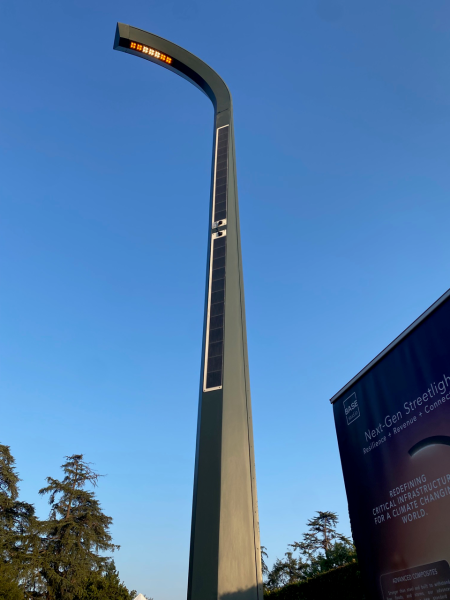
“Greater Palm Springs sits at the intersection of one of the most dynamic climate ecosystems on Earth and rapid growth,” Adams adds. “That combination is exactly what makes it compelling for advanced manufacturing.”
The combination of real-world validation paired with the ability to scale is the Greater Palm Springs advantage. It’s not simply that products are built and tested in Greater Palm Springs, but that once they’re ready here, they can be successfully deployed elsewhere.
“Every major deployment we take on will trace its roots back to a parking lot in Rancho Mirage,” Adams notes. “The desert proved our technology works. Now the rest of the world gets to find out.”